Three systems, three numbers, one very tired analyst. The instinct is to hunt for the broken tag. The more useful move is to understand that these platforms disagree structurally and to build the layer that reconciles them instead of forcing them to match.
The Real Problem
These three systems are not three attempts to measure the same thing. They are three different measurements that happen to share a word.
The meeting everyone in B2B SaaS has sat through
Someone pulls last month's conversions from Mixpanel. Someone else pulls the same month from GA4. Finance pulls Stripe.
Three numbers. Not one of them matches.
What follows is predictable: a hunt for the bug, a review of the tag manager, a suspicion that someone's implementation is wrong. Occasionally that's true. Usually it isn't.
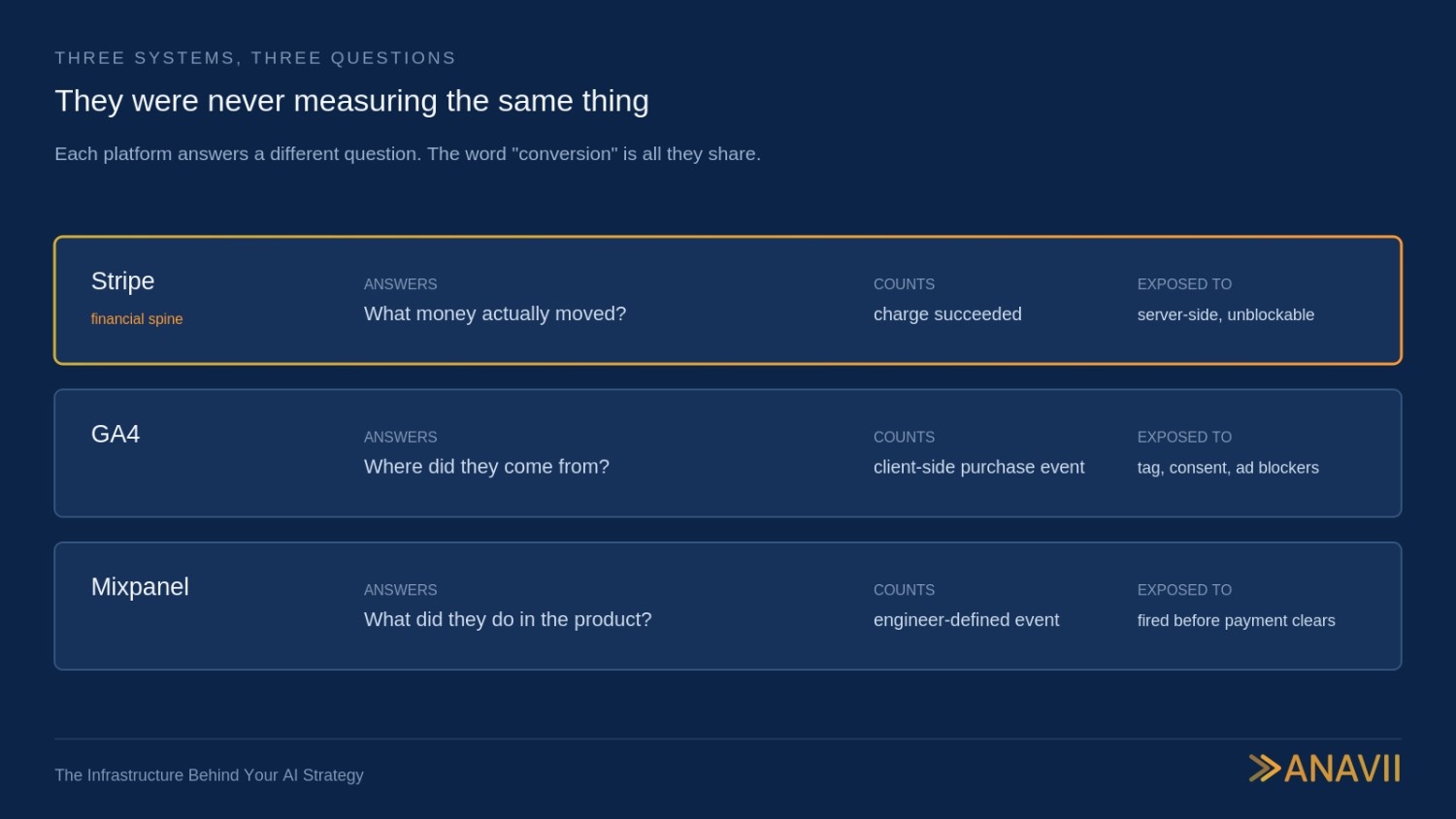
They disagree for three structural reasons
🔍 Reason 1: They don't agree on who a user is
Mixpanel is user-centric. It resolves identity around a distinct_id, merging anonymous activity into a known user when you call identify. Wired correctly, someone who browses on mobile and converts on desktop is one person.
GA4 is device- and session-centric by default. Its identifier lives in a browser cookie, so unless you explicitly turn on User-ID, the same person on two devices counts as two people. GA4 also approximates its user counts rather than tallying them exactly accurate at scale, but never a number you can reconcile down to the row.
Stripe is customer-centric, but its customer is a billing entity. It has no concept of the anonymous session that preceded signup.
Every conversion rate you calculate has a different denominator depending on which system produced it. That alone guarantees the numbers diverge.
💳 Reason 2: They don't agree on what a purchase is
Stripe records a charge that succeeded. It's server-side, financial, and unambiguous. Nothing blocks it.
GA4 records a purchase event most commonly one that fires client-side, from the browser. That requires the confirmation page to load, the tag to fire, the user not to close the tab, no ad blocker, and consent to be granted. Ad blocker usage skews high among technical and B2B audiences, so a structural undercount exists before anything is misconfigured. Server-side tagging closes the ad-blocker gap, but it is less common in the mid-market and it does nothing about the identity, attribution, and timing differences below.
Mixpanel records whatever event a developer named "Purchase." In practice, that's frequently fired on the client at checkout submit which counts declined cards, abandoned 3DS challenges, and duplicate clicks as conversions.
⏱️ Reason 3: They don't agree on when it happened
Stripe stamps the charge at payment capture, and that charge has a lifecycle afterward: it can be refunded next week or disputed next month.
GA4 processes on a delay, commonly cited at 24 to 48 hours, then applies its own attribution model and windows on top.
Mixpanel ingests close to real time, but mobile SDKs queue events offline and deliver them late.
Compare any single day across the three and you are comparing three different snapshots of three different clocks.
Subscriptions turn a gap into a chasm
Everything above applies to any business. Subscription models add failure modes that are specific and, in our experience, the most common source of executive confusion.
Annual plans break the revenue line. A $1,200 annual plan is one charge in Stripe and $100 of MRR. GA4 books $1,200 of revenue on the signup date. Your revenue chart now has a spike that finance does not recognize. And because annual plans are usually sold at a discount to monthly, the effective MRR is lower still so even the derived figure needs a stated rule.
Trials are invisible to finance. A trial start and a trial conversion are the two most important events in your product funnel, and both are $0 in Stripe until the trial converts.
Proration looks like noise. A mid-cycle upgrade generates a small prorated charge that appears in transaction counts as an odd, tiny purchase inflating order counts and destroying average order value.
Dunning decouples access from payment. When a renewal fails, Stripe moves the subscription to past_due and drops it from MRR as delinquent but the customer usually keeps product access through the retry window. Product analytics still counts them as active. Cash says otherwise.
Refunds are asymmetric. Stripe reverses them cleanly. GA4 keeps counting the original purchase indefinitely unless a refund event is explicitly sent back so GA4 revenue drifts permanently upward over time.
The wrong fix: making them match
The common response is to force alignment retag everything, adjust attribution windows, add a connector, and chase the delta toward zero.
It doesn't work, and it's the wrong goal. You can eliminate implementation error, and you should. You cannot eliminate structural difference, because the systems are built to answer different questions. A team that spends a quarter chasing an unreachable zero ends up trusting nothing.
The right fix: one number everyone trusts
Stop trying to make the tools agree. Give each one the job it's actually good at, and reconcile all three against the money.

Stripe is the financial truth. It's the only system that knows what money actually moved, so every revenue, MRR, refund, and churn figure is anchored to it.
GA4 explains acquisition where the customer came from, which campaign, which content. Read for what it's good at, not treated as a revenue ledger.
Mixpanel explains behavior what they did in the product, where activation stalled, which features precede retention.
Reconciled against Stripe, those three stop competing and start complementing: one agreed number for revenue, and three lenses that each answer the question they were built for.
"The one thing that has to be right is identity the same customer being recognizable across all three. It's the piece teams most often skip and the hardest to add later, because the moment that matters most, the touch that created a paying customer, happens before anyone is even a known user."
Wire it in early and everything downstream joins up. Skip it, and no dashboard, connector, or tool you buy afterward fully recovers it.
None of this is exotic. But it looks far simpler on a slide than it is in practice, and the failure modes are the kind you only find on your own production data over a couple of quarters which is exactly why it's worth having built by people who have done it before.
What good looks like
Reconciled correctly, the variance between systems stops being a mystery and becomes a monitored, explainable number. In a given environment you might know that GA4 runs, say, 12% below Stripe because of client-side loss and, more importantly, you know something is wrong the day that gap jumps to 30%.
That's the real prize. Not three systems that agree three systems whose disagreement you understand precisely enough that a change in it becomes an alarm.
The dashboard was never the problem. Neither were the tags.
"Stop hunting for the perfect alignment. Start measuring the predictable gap. The difference between them is where truth lives."